How to Make Smarter Decisions with Weighted Comparison Matrices
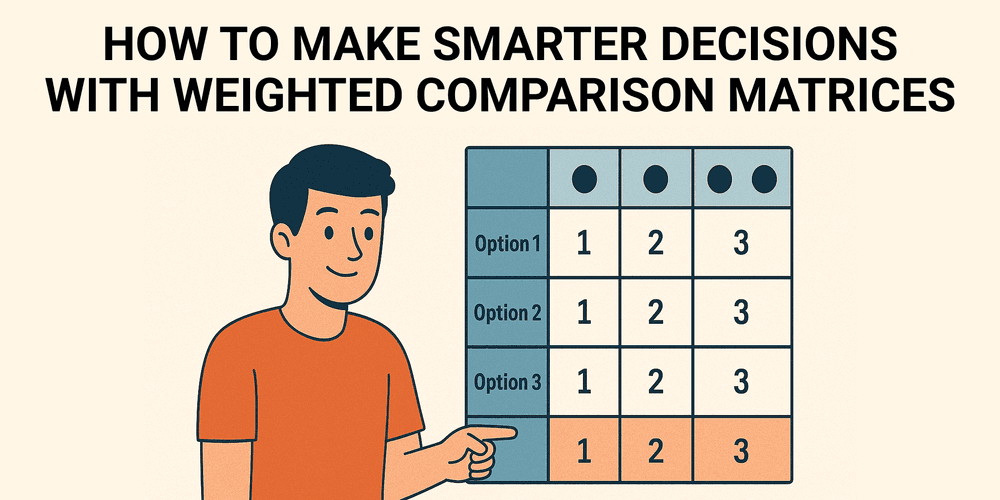
Structured comparison beats impulsive decision-making every time.- Tilak Dhameliya
Why We Need a Decision Matrix
Every day, we make countless decisions — some minor, some major. From picking a new laptop, smartphone, or service, to choosing a job offer, travel destination, or even which fitness plan to follow, the choices can feel overwhelming.
Many people rely on instinct, scattered research, or opinions from others, which can result in suboptimal decisions, wasted time, or regret.
A decision matrix is a structured tool that helps you:
- Organize information clearly
- Compare multiple options side by side
- Prioritize what matters most
- Remove emotion-driven or ad-hoc decision-making
By adding weights, you emphasize the factors that matter most to you, ensuring your choices reflect your priorities, not just impulse.
What Is a Weighted Comparison Matrix?
A weighted comparison matrix is a simple yet powerful tool to make better choices. The process involves:
- Listing your options (e.g., Option A, B, C)
- Defining your criteria (e.g., price, performance, brand)
- Assigning weights to each criterion (e.g., performance = 30%, price = 20%)
- Scoring each option on each criterion (1–5 or 1–10 scale)
- Multiplying scores by weights and summing them up
- Selecting the option with the highest total score
Why it works:
- Makes comparison transparent
- Clarifies priorities
- Reduces bias from emotions or external opinions
Step-by-Step Guide: Building Your First Matrix
1. Choose Your Decision Topic
Start with a decision that involves multiple options and criteria. Examples include:
- Choosing a laptop for remote work
- Selecting a smartphone
- Comparing vacation destinations
- Deciding between job offers
- Evaluating software tools
For this example, let’s choose three laptops:
- Laptop A: Ultrabook, long battery life
- Laptop B: Gaming-grade performance
- Laptop C: Budget-friendly, lightweight
Explore laptop comparison tools
2. Define Your Criteria
Identify the key factors that matter for your decision. For laptops, possible criteria include:
- Performance
- Battery life
- Portability
- Price
- Brand reliability
💡 Tip: Stick to 5–7 key criteria to avoid overcomplicating the matrix. Too many factors can dilute the decision-making process.
3. Assign Weights
Different decisions require different priorities. Weights allow you to emphasize what matters most. For remote work, you might assign:
- Battery life – 30%
- Portability – 25%
- Performance – 20%
- Price – 15%
- Brand reliability – 10%
Make sure the total equals 100%.
💡 Tip: You can use SmartDecide to adjust weights visually, seeing how each change impacts the final score.
4. Score Each Option
Evaluate each laptop on a scale of 1–5 (or 1–10) for each criterion:
| Laptop | Performance | Battery | Portability | Price | Brand |
|---|---|---|---|---|---|
| Laptop A | 4 | 5 | 5 | 3 | 4 |
| Laptop B | 5 | 3 | 2 | 2 | 3 |
| Laptop C | 3 | 4 | 4 | 5 | 3 |
💡 Tip: Be consistent and honest. Check reviews, benchmark results, and user feedback to assign accurate scores.
5. Multiply Scores by Weights and Sum
Multiply each score by its weight and sum them up to get a total score:
| Laptop | Total Score |
|---|---|
| Laptop A | 4.15 |
| Laptop B | 2.95 |
| Laptop C | 3.95 |
Result: Laptop A wins — a clear, structured approach makes the decision obvious.
Real-Life Use Cases
Weighted matrices are versatile and can be applied across many areas:
Career Decisions
Compare multiple job offers based on salary, location, work-life balance, and growth potential.
Example: Weight salary 30%, growth 25%, work-life balance 20%, location 15%, company brand 10%.
Travel Planning
Choose between destinations based on cost, activities, accessibility, and weather.
Example: Weight cost 25%, activities 30%, accessibility 20%, weather 25%.
Product Comparisons
Compare phones, laptops, or software tools.
Example: Weight performance 30%, battery 25%, price 20%, camera 25%.
Life Choices
Evaluate financial decisions, like choosing investments or subscription services.
Example: Weight return 40%, risk 30%, liquidity 20%, fees 10%.
💡 Tip: Weighted matrices reduce indecision by making priorities explicit and quantifiable.
Why Weighted Matrices Work
Weighted matrices improve decision-making by:
- Objectivity: Clear criteria and weights reduce bias
- Personalization: Customize based on what matters to you
- Adaptability: Applicable for personal, professional, and financial decisions
- Repeatability: Use the same method for future decisions
Using SmartDecide to Automate Your Matrix
Manual matrices are effective, but tedious. SmartDecide automates the process:
- Add options quickly
- Assign and adjust weights visually
- Let SmartDecide calculate totals automatically
- Generate clear, visual outputs
- Save and revisit your matrices anytime
SmartDecide can be used for anything — tech, services, travel, or life choices.
When to Use a Weighted Matrix
Weighted matrices are ideal when:
- You have 3–10 options
- Your decision involves 3 or more measurable criteria
- Some factors are more important than others
- You want logic-backed clarity
For simple decisions, like choosing between two options, a matrix may be unnecessary. For non-trivial choices, it’s a powerful tool.
Common Pitfalls & How to Avoid Them
- Too many criteria: Stick to 5–7 key factors
- Unbalanced weights: Ensure the total is 100%
- Subjective scoring: Use objective benchmarks whenever possible
- Ignoring gut feeling: If scores are close, intuition can be the tie-breaker
💡 Pro Tip: Combine structured analysis with intuition for best results.
FAQs About Weighted Matrices
Q1: Can I use weighted matrices for personal decisions?
A: Yes! From buying gadgets to vacation planning, any multi-criteria decision benefits.
Q2: What scale should I use for scoring?
A: Use 1–5 for simplicity or 1–10 for finer differentiation. Be consistent.
Q3: How often should I adjust weights?
A: Weights should reflect your current priorities. Reassess if priorities change.
Q4: Can SmartDecide handle multiple decision types?
A: Absolutely — SmartDecide works for products, services, jobs, travel, or life choices.
Final Thoughts
In a world full of choices, a structured decision-making approach is invaluable. Weighted matrices combine logic and self-awareness into a simple, repeatable process.
SmartDecide automates the entire workflow, eliminating spreadsheets and manual calculations, making decision-making fast, clear, and data-driven.
Start using weighted matrices today and make smarter, confident decisions every time.
Share: